
Welcome to LexCall
Verified Legal Advisory Across India
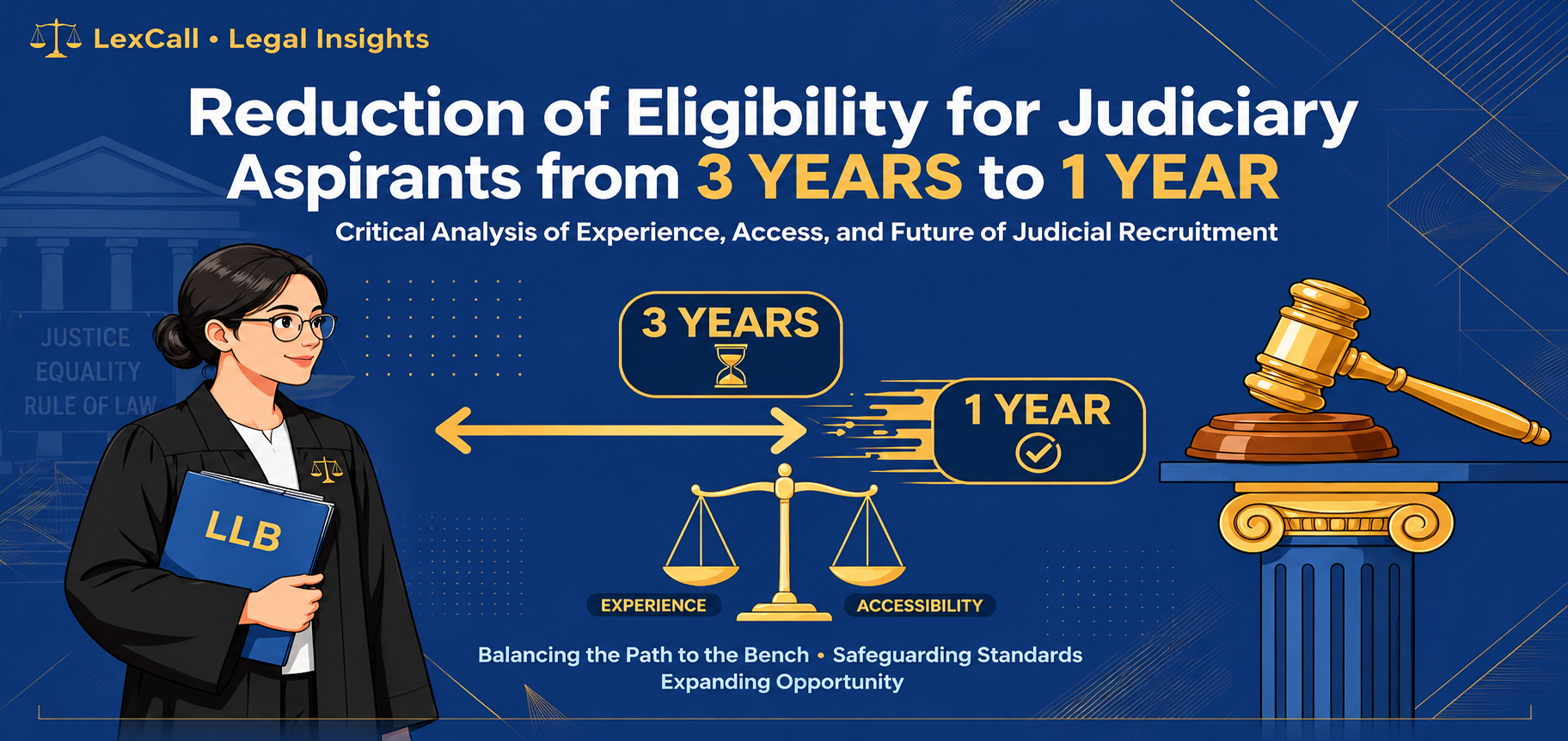
“Reduction of Eligibility for Judiciary Aspirants from 3 Years to 1 Year”
The judicial services examination is one of the most respected routes into the Indian judiciary. For many years, however, the question of who should be eligible to appear for entry-level judicial examinations has remained a matter of debate. A major proposal in this debate is the reduction of the minimum legal-practice requirement for judiciary aspirants from three years to one year.
Share on social media
About “Reduction of Eligibility for Judiciary Aspirants from 3 Years to 1 Year”
Reduction of Eligibility for Judiciary Aspirants from 3 Years to 1 Year
(A Critical Analysis of Experience, Access, and the Future of Judicial Recruitment)
Introduction
The judicial services examination is one of the most respected routes into the Indian judiciary. For many years, however, the question of who should be eligible to appear for entry-level judicial examinations has remained a matter of debate. A major proposal in this debate is the reduction of the minimum legal-practice requirement for judiciary aspirants from three years to one year. Such a change would directly affect law graduates, young advocates, legal education, the recruitment process, and ultimately the quality of the judicial system.
The idea of reducing the requirement from three years to one year is attractive because it can make the judicial career more accessible to young law graduates. At the same time, practical courtroom exposure is an important component of becoming an effective judge. A judge must understand not only statutes and precedents but also pleadings, evidence, procedure, advocacy, courtroom discipline, and the realities faced by litigants. Therefore, the debate is not simply about reducing a number from three to one; it is about finding the right balance between accessibility and professional experience.
Background of the Eligibility Debate
The eligibility conditions for entry-level judicial service recruitment have changed over time and can vary depending on the applicable constitutional, statutory, and judicial framework. The three-year practice requirement has often been defended on the ground that a person who has spent time in actual legal practice is better prepared to understand the functioning of courts. Practice can expose a young lawyer to filing procedures, arguments, examination and cross-examination of witnesses, drafting, client interaction, and ethical responsibilities.
However, a mandatory multi-year practice period can also create difficulties. Newly qualified lawyers may struggle financially during the initial years of practice. Many young advocates depend on senior lawyers or family support while building a practice. For candidates whose primary goal is judicial service, being required to spend several years in practice before becoming eligible may make the career path longer and less predictable. The proposed reduction to one year therefore raises a legitimate question: can meaningful professional exposure be ensured without keeping talented graduates away from judicial recruitment for too long?
Why the One-Year Requirement Could Be Beneficial
The strongest argument in favour of reducing the requirement to one year is increased opportunity. Law students who have worked hard throughout their degree and prepared seriously for judicial examinations could enter the recruitment process earlier. This may reduce the age at which successful candidates begin judicial careers and provide a clearer pathway from legal education to public service.
A shorter practice requirement may also improve diversity among candidates. Not every law graduate has equal financial resources to spend several years building a private practice. Students from middle-income and economically weaker backgrounds may find it difficult to sustain themselves during the early years of advocacy. A one-year requirement could reduce this financial barrier and allow merit and preparation to play a larger role.
Another possible advantage is the early development of judicial talent. Candidates who demonstrate strong knowledge of law, reasoning ability, language skills, judgment, integrity, and constitutional understanding could be selected at a younger age and then receive structured judicial training. Instead of expecting young advocates to acquire every practical skill independently, judicial academies could provide intensive training before and during their initial years of service.
The Importance of Practical Legal Experience
Despite these advantages, reducing the requirement to one year should not lead to the conclusion that practical experience is unimportant. Judicial work is fundamentally connected with the realities of litigation. A judge deals with conflicting versions of facts, procedural applications, evidence, arguments by opposing counsel, and the consequences of judicial orders on real people.
Courtroom experience can teach lessons that are difficult to acquire solely through textbooks or examination preparation. An advocate learns how a case actually moves through the judicial system, how documents are prepared and challenged, how procedural delays occur, and how litigants and lawyers interact with the court. Even a short period of meaningful practice can provide valuable exposure, but the quality of that experience matters as much as its duration.
This is why the debate should move away from simply asking whether one year is better than three years. The more important question is what kind of professional experience a prospective judge should possess before appointment. A candidate with one year of intensive, genuine courtroom exposure may have more practical understanding than someone who technically satisfies a longer period but has had limited independent involvement in cases.
Possible Risks of Reducing the Period
A reduction in the practice requirement may create concerns about judicial maturity. Judges are required to make decisions that affect liberty, property, family relationships, commercial interests, and public rights. Legal knowledge is essential, but judicial temperament and practical judgment develop through experience.
There is also a risk that candidates may treat the one-year practice period merely as a formal eligibility condition. If practice becomes only a certificate-based requirement, the intended benefit of professional exposure may be lost. Therefore, any one-year model should include a reliable method of verifying genuine practice.
Another concern is the workload of judicial training institutions. If candidates enter judicial service with less experience, academies will have to provide stronger training in evidence appreciation, civil and criminal procedure, judgment writing, case management, mediation, technology, ethics, and courtroom administration. Without such training, reducing eligibility could create a gap between theoretical knowledge and practical competence.
A Better Model: One Year of Genuine Practice Plus Strong Training
A balanced approach would combine a one-year practice requirement with a structured professional-training system. Candidates could be required to demonstrate actual legal work through verifiable court appearances, drafting, case-related work, or other recognised professional activities. The purpose should be to ensure that the candidate has genuinely experienced the legal system rather than merely completed a formal waiting period.
After selection, judicial trainees could undergo a rigorous foundation course followed by supervised practical training. This could include observation of senior judges, mock trials, judgment-writing exercises, evidence analysis, court-management training, mediation, legal research, and interaction with prosecutors and defence counsel. A structured probation period could further ensure that newly appointed judges develop competence before receiving extensive independent responsibilities.
Such a model could preserve the principal advantage of experience while removing unnecessary barriers for young and capable candidates. It would also shift the focus from the quantity of years spent in practice to the quality of professional preparation.
Impact on Law Students and Young Advocates
For law students, the proposed reduction could significantly change career planning. Judicial service preparation could begin earlier, and students would have greater flexibility in deciding whether to pursue litigation, corporate practice, academia, or judicial service. A one-year practice requirement could also encourage students to obtain real courtroom exposure instead of preparing exclusively through theoretical study.
For young advocates, however, the reform should not send the message that advocacy is merely a waiting period before entering the judiciary. Litigation remains an important profession in its own right and contributes to the development of judges, legal doctrine, and access to justice. A good reform should therefore encourage meaningful legal practice while allowing those who are committed to judicial service to compete for recruitment without an unnecessarily long delay.
Need for Uniformity and Clarity
Any reduction in eligibility must be accompanied by clear and uniform rules. Candidates should know exactly what constitutes legal practice, how the one-year period will be calculated, what documents must be submitted, and how genuine practice will be verified. Ambiguous requirements can lead to unequal treatment and unnecessary litigation.
The recruitment authorities should also ensure that the examination process continues to test more than memory. A modern judicial examination should assess legal reasoning, interpretation, problem-solving, judgment writing, procedural understanding, ethics, and practical application of law. If eligibility is reduced, the selection process becomes even more important because it must identify candidates who possess both intellectual ability and judicial potential.
Conclusion
The proposal to reduce the eligibility requirement for judiciary aspirants from three years to one year represents a significant shift in the philosophy of judicial recruitment. It recognises that talented young law graduates should not necessarily have to wait several years before competing for public judicial service. It can improve accessibility, reduce financial barriers, and create a faster and more transparent career pathway.
At the same time, the judiciary cannot afford to ignore the value of practical legal experience. A judge needs more than examination knowledge; a judge needs maturity, courtroom understanding, procedural competence, and sound judgment. Therefore, the success of a one-year model would depend not simply on reducing the eligibility period but on ensuring that the year of practice is genuine and that judicial training is sufficiently rigorous.
Ultimately, the best policy would be one that combines early opportunity with strong professional preparation. If one year of verified practice is followed by comprehensive judicial training, supervised exposure, and a meaningful probation system, the reform could provide a reasonable balance between youth and experience. The objective should not be to produce judges who are merely eligible at a younger age, but judges who are competent, ethical, independent, and capable of delivering justice effectively.
Recent Posts

Can a Democracy Survive if It's Own Exec...
Read More
When Roads Become Traps and Rivers Turn...
Read More
Poison in the Pump: India’s Hidden Urani...
Read More
Aravalli Hills: When a Hill Has to Measu...
Read More
Men’s Rights in India — Finally Getting...
Read More
Some Words Get FIRs. Some Get Standing O...
Read More
India Rewrites the Rules of Work: Why th...
Read More
When the Files Became Too Heavy: A Saket...
Read More
“The Role of Mediation and Arbitration i...
Read More
“Reduction of Eligibility for Judiciary...
Read More