Welcome to LexCall
Verified Legal Advisory Across India
“The Role of Mediation and Arbitration in Resolving Disputes”
Disagreements are a common feature of personal relationships, business transactions, employment, and commercial activities. While courts remain an important avenue for obtaining justice, traditional litigation can involve considerable time, expense, procedural complexity, and uncertainty. These concerns have increased interest in Alternative Dispute Resolution (ADR).
Share on social media
About “The Role of Mediation and Arbitration in Resolving Disputes”
The Role of Mediation and Arbitration in Resolving Disputes
Introduction
Disagreements are a common feature of personal relationships, business transactions, employment, and commercial activities. While courts remain an important avenue for obtaining justice, traditional litigation can involve considerable time, expense, procedural complexity, and uncertainty. These concerns have increased interest in Alternative Dispute Resolution (ADR).
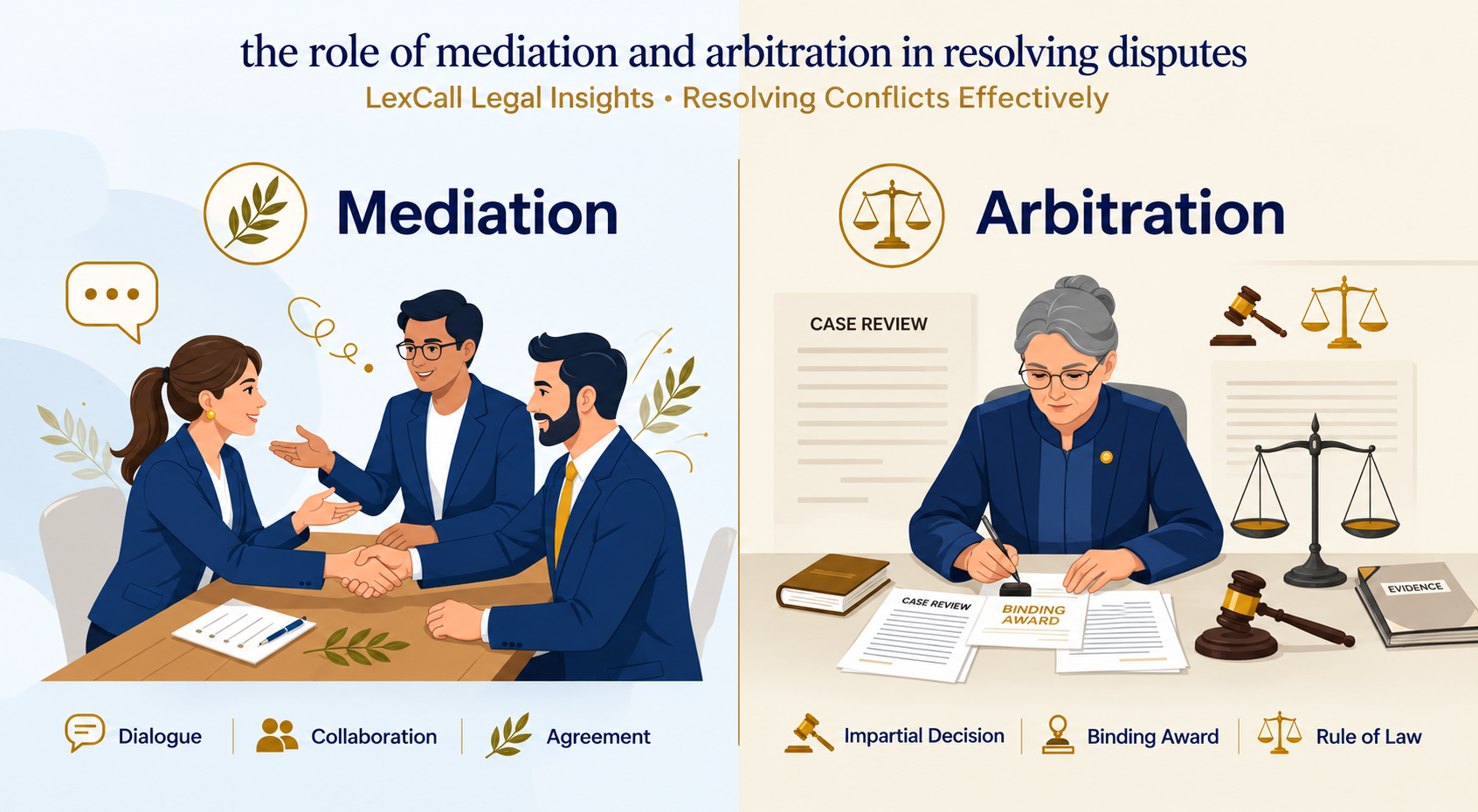
Mediation and arbitration are two of the most significant ADR mechanisms. Both provide alternatives to conventional litigation, but they follow fundamentally different approaches. Mediation encourages the disputing parties to negotiate a mutually acceptable solution, whereas arbitration places the dispute before an independent decision-maker who determines the matter.
The growing use of these mechanisms reflects a broader movement towards making dispute resolution more accessible, efficient, flexible, and responsive to the needs of the parties.
Understanding Alternative Dispute Resolution
Alternative Dispute Resolution encompasses various processes through which parties attempt to settle disputes without pursuing a conventional court trial. Depending on the circumstances, ADR can provide parties with greater participation in the resolution process and may reduce the time and resources required to settle a disagreement.
Among the different forms of ADR, mediation and arbitration occupy a particularly important position. Although they share certain characteristics, such as the involvement of a neutral third party and the possibility of resolving disputes outside court, their purposes and procedures are distinct.
Mediation: A Negotiated Approach to Dispute Resolution
Mediation is essentially a facilitated negotiation. In this process, an impartial person known as a mediator assists the parties in communicating with each other and examining possible ways of settling their dispute.
The mediator does not ordinarily decide who is right or wrong. Instead, the mediator helps the participants identify the issues that separate them, understand their respective concerns, and consider possible compromises.
One of the most significant characteristics of mediation is that the parties themselves remain responsible for deciding whether a settlement should be reached and what that settlement should contain.
Important Features of Mediation
Mediation offers several characteristics that distinguish it from conventional litigation:
Party participation: The parties actively participate in developing the solution.
Flexibility: Discussions can be adapted to the specific circumstances of the dispute.
Privacy: Mediation is generally conducted in a private setting.
Confidentiality: Subject to the applicable legal framework and any agreed terms, information shared during mediation is generally treated as confidential.
Relationship preservation: Because mediation encourages dialogue rather than an adversarial contest, it may help preserve long-term personal or commercial relationships.
Mediation can therefore be particularly useful where the parties have an ongoing relationship and want a solution that addresses practical concerns in addition to strictly legal rights.
Arbitration: A Decision-Based Process
Arbitration takes a different approach. Instead of relying on the parties to reach their own settlement, the dispute is presented to an independent arbitrator or arbitral tribunal for determination.
The arbitrator examines the material presented by the parties and conducts the proceedings in accordance with the applicable arbitration agreement, rules, and law. The process generally concludes with an arbitral award, which may be binding on the parties and enforceable subject to the relevant legal provisions.
Arbitration is frequently used in commercial and contractual disputes. Businesses may choose arbitration because it can provide a private forum and, in appropriate cases, allow disputes to be considered by individuals possessing knowledge of a particular industry or technical field.
Mediation and Arbitration
The most important distinction between the two mechanisms concerns who controls the outcome.
In mediation, the parties control the final settlement. A mediator assists them but does not normally impose a decision. If the parties cannot agree, mediation may end without a settlement.
In arbitration, the arbitrator determines the dispute. The parties present their respective positions and evidence, after which the arbitrator issues an award in accordance with the applicable framework.
Mediation | Arbitration |
|---|---|
Focuses on negotiation | Focuses on adjudication |
Parties develop the solution | Arbitrator determines the dispute |
Mediator facilitates communication | Arbitrator evaluates the dispute |
Settlement depends on agreement | Generally concludes with an arbitral award |
Often highly flexible | Usually follows an established procedural framework |
The choice between the two therefore depends largely on what the parties require from the dispute-resolution process.
How Mediation Contributes to Effective Dispute Resolution
Mediation can transform the way parties approach a disagreement. Litigation often places parties in opposing positions, whereas mediation creates an opportunity to discuss the underlying interests behind those positions.
For instance, two businesses may disagree over the performance of a contract. One party may primarily want financial compensation, while the other may be more interested in continuing the commercial relationship. A court judgment may determine legal liability, but mediation may enable the parties to design a broader settlement involving payment, revised contractual terms, future cooperation, or other practical arrangements.
This ability to consider solutions beyond a strict legal remedy is one of mediation's greatest strengths.
How Arbitration Contributes to Effective Dispute Resolution
Arbitration provides an alternative where parties want a neutral person to determine their dispute rather than relying entirely on negotiation.
Its potential value is particularly apparent in complex commercial matters. Certain disputes involve specialised industries, technical contracts, construction projects, international transactions, or complicated financial arrangements. In suitable cases, parties may benefit from a decision-maker who has relevant knowledge or experience.
Arbitration can also offer procedural flexibility. The parties may have agreed in advance on matters such as the arbitral institution, number of arbitrators, applicable rules, or seat of arbitration. However, the precise procedure and legal consequences depend on the agreement and the governing law.
Advantages of Mediation and Arbitration
Saving Time and Resources
A major reason parties consider ADR is the possibility of resolving disputes more efficiently than through lengthy court proceedings. The actual duration and expense will depend on the complexity of the matter, the conduct of the parties, and the applicable procedure, but ADR can sometimes reduce unnecessary procedural delays.
Greater Privacy
Privacy can be particularly valuable in commercial disputes. Businesses may wish to avoid unnecessary public exposure of sensitive contractual, financial, or operational information. Mediation and arbitration generally provide a more private environment than conventional public court proceedings, although the extent of confidentiality depends on the applicable law, rules, and agreements.
Greater Flexibility
ADR allows parties, within the limits imposed by applicable law, to structure aspects of the process according to their circumstances. This flexibility can make the process more practical for specialised or commercially sensitive disputes.
Preserving Business Relationships
A dispute does not necessarily mean that a business relationship must end. Mediation can encourage constructive communication and help parties find solutions that allow their relationship to continue.
Access to Specialist Decision-Makers
In arbitration, parties may have the opportunity to select or participate in the appointment of an arbitrator with appropriate professional or technical expertise. This can be useful where the dispute involves specialised subject matter.
Choosing Between Mediation and Arbitration
There is no universal rule that makes one mechanism better than the other. The appropriate option depends on the circumstances.
Mediation may be more suitable when the parties:
Want to negotiate a mutually acceptable settlement.
Have an ongoing relationship they wish to preserve.
Prefer to retain control over the outcome.
Are willing to communicate and consider compromise.
Need a flexible approach to resolving their disagreement.
Arbitration may be more appropriate when the parties:
Require an independent determination of their dispute.
Have an enforceable arbitration agreement.
Prefer a private adjudicatory process.
Are dealing with technically or commercially complex issues.
Want the dispute to culminate in an arbitral award.
In some situations, mediation and arbitration can complement one another. Parties may first attempt to negotiate a settlement through mediation and, if that effort does not succeed, proceed to arbitration where their agreement and applicable law permit it.
Limitations and Challenges
Despite their advantages, mediation and arbitration are not suitable for every dispute.
Mediation depends substantially on the willingness of the parties to engage honestly and consider possible solutions. If one party is unwilling to negotiate meaningfully, the process may not produce a settlement.
Arbitration also has potential drawbacks. Complex arbitrations can become costly and lengthy, particularly when they involve extensive evidence, multiple parties, technical experts, or lengthy hearings. Further, the grounds for challenging an arbitral award are generally narrower than the avenues available in ordinary litigation.
Accordingly, parties should not select an ADR mechanism simply because it is described as faster or cheaper. They should examine the specific circumstances of the dispute and consider the applicable agreement, law, procedure, costs, and desired outcome.
The Increasing Importance of ADR
Modern commercial activity frequently involves parties operating across different cities, states, and countries. As business relationships become more complex, the need for reliable and efficient methods of resolving disagreements has also increased.
Mediation and arbitration respond to this need by offering alternatives to conventional litigation. They give parties additional choices concerning how their disputes should be addressed and can, in appropriate circumstances, reduce the pressure placed on judicial systems.
Their importance is therefore not limited to avoiding court proceedings. ADR represents a broader shift towards dispute-resolution processes that encourage participation, efficiency, privacy, and specialised decision-making.
Conclusion
Mediation and arbitration have become significant components of contemporary dispute resolution. Although both provide alternatives to traditional litigation, they serve different purposes.
Mediation emphasises dialogue and negotiated settlement, allowing the parties to retain control over the ultimate outcome. Arbitration provides a structured process in which an independent arbitrator determines the dispute, generally through a binding award.
The effectiveness of either mechanism depends on the nature of the dispute, the relationship between the parties, the terms of any existing agreement, and the applicable legal framework. When selected and implemented appropriately, mediation and arbitration can provide practical avenues for resolving disputes while reducing unnecessary confrontation and procedural burden.
Ultimately, the value of ADR lies in giving disputing parties meaningful alternatives. Rather than treating every disagreement as a matter that must culminate in traditional litigation, mediation and arbitration allow parties to consider dispute-resolution processes that may better suit their legal, commercial, and practical interests.
Recent Posts

Can a Democracy Survive if It's Own Exec...
Read More
When Roads Become Traps and Rivers Turn...
Read More
Poison in the Pump: India’s Hidden Urani...
Read More
Aravalli Hills: When a Hill Has to Measu...
Read More
Men’s Rights in India — Finally Getting...
Read More
Some Words Get FIRs. Some Get Standing O...
Read More
India Rewrites the Rules of Work: Why th...
Read More
When the Files Became Too Heavy: A Saket...
Read More
“The Role of Mediation and Arbitration i...
Read More
“Reduction of Eligibility for Judiciary...
Read More